FROM August 6th, 2026
LONDON and LAGOS, August 5th 2026
Her Excellency Mrs Toyin Ojora Saraki, Founder-President of the Wellbeing Foundation Africa, joins the Advisory Board of SyloCare, a health coverage platform enabling members of the African diaspora in the United Kingdom, the United States and Canada to arrange licensed health insurance for family members in Nigeria, Ghana and Kenya.
Her Excellency serves in a personal capacity, offering strategic counsel on health policy positioning, impact measurement and alignment with global health frameworks.
The appointment addresses a long-standing gap in health financing across the continent. Households across sub-Saharan Africa continue to meet a substantial share of health costs directly at the point of care, and the diaspora has for decades absorbed that burden through remittances sent in response to emergency rather than in anticipation of need. Structured, prepaid coverage arranged from abroad offers one route towards moving protection ahead of crisis.
“Across the continent, families continue to meet the cost of care at the very moment they can least afford it, and that burden falls most heavily upon women, upon newborns, upon the elderly and upon the households that sustain them. The diaspora has long carried this weight through remittances sent in emergency, arriving after illness has already taken hold rather than before it.
I have accepted this advisory role in my personal capacity because the question of how families finance their health is inseparable from the question of whether they survive it, and because any mechanism that seeks to move protection ahead of crisis deserves careful and candid counsel.
My contribution will be to ask the questions that matter, among them how such a platform reaches the families furthest from care, how it holds itself accountable to those whose treatment depends upon it, and how it aligns with the normative direction set by universal health coverage.”
— Her Excellency Mrs Toyin Ojora Saraki
Founder-President, The Wellbeing Foundation Africa
“Her Excellency has spent over two decades ensuring that the health of mothers and newborns is treated as a matter of institutional decision and public accountability rather than private misfortune.
Her willingness to advise us, and to hold us to a high standard as we grow, is something we do not take lightly. We are building SyloCare so that a daughter in London can arrange cover today and her mother in Abuja can see a doctor tomorrow, and we want that promise tested by someone who has spent her career insisting such promises are kept.”
— Jay Chikezie
Founder and Chief Executive Officer, SyloCare
About Her Excellency Mrs Toyin Ojora Saraki
Her Excellency Mrs Toyin Ojora Saraki is the Founder-President of the Wellbeing Foundation Africa and of the Wellbeing Africa Institute for Research and Development. She is the Inaugural Global Health Ambassador of the WHO Foundation, a UNFPA Nigeria Family Planning Champion, and a Champion of the World Economic Forum’s Global Alliance for Women’s Health. For more than two decades, she has advanced maternal, newborn, child and adolescent health across sub-Saharan Africa through frontline programming, advocacy and sustained engagement with governments and multilateral institutions.
About SyloCare
SyloCare is a health insurance aggregation platform operated by Tremendoc Limited, a company registered in England and Wales. The platform enables members of the African diaspora in the United Kingdom, the United States and Canada to arrange licensed health coverage for family members in Nigeria, Ghana and Kenya through vetted health maintenance organisation partners.
Media Contact
Zelia Bukhari, Director of Global Health Policy and Advocacy
The Toyin Saraki Global Policy and Philanthropy Office
zelia.bukhari@wbfafrica.org
FROM September 19th, 2023
New York, United States – The year 2023, midpoint of the United Nations Sustainable Development Goals, marks a critical turning point in the global conversation around adolescent wellbeing and maternal healthcare. The Wellbeing Foundation Africa was proud to join the Clinton Global Initiative (CGI) meeting this September, bringing together influential global players to address the pressing needs of adolescents and to shine a light on a critical, often-overlooked phase of maternal health: the fourth trimester.
More than ten global organisations, including the Wellbeing Foundation Africa in partnership with Reckitt joined forces with Fondation Botnar to commit to action aimed at tackling the challenges faced by the world’s 1.8 billion adolescents, including water, sanitation and hygiene, focused on our programming, Dettol Nigeria Hygiene Quest.
Alongside this, at CGI, I was honoured to contribute to ‘The Fourth Trimester: How to Provide Postpartum Support and Reduce Post-Birth Mortality’, addressing the critical issue that demands our immediate attention: the fourth trimester, that often-overlooked period from birth to 12 weeks. This is a time when the delicate dance of mother-baby bonding unfolds, and mothers embark on the journey of physical recovery from childbirth.
This phase represents a time of profound vulnerability for mothers as they navigate physical and emotional changes, including sleep deprivation, hormonal fluctuations, and the responsibility of nurturing a newborn. Unfortunately, inadequate support during the fourth trimester can lead to long-term health issues, including postpartum depression, anxiety, and increased risk of chronic illnesses.
Nigeria, like the United States, faces similar challenges in maternal healthcare. Maternal mortality rates remain a pressing concern, particularly for black, asian and minority ethnic rural and underserved communities in the USA. In this pivotal moment in history, it is imperative that we recognize the urgency of these matters and take global action to ensure that mothers and babies not only survive but thrive during the critical phases of healthcare.
As we unite in our efforts to protect the wellbeing of mothers, their newborns and adolescents worldwide, let us forge a path toward a brighter, healthier future.
View this post on Instagram
FROM September 28th, 2020
Throughout the pandemic, my Wellbeing Foundation Africa’s dedicated groundforce of 47 professional community midwives have stretched themselves to the furthest villages in Nigeria, to continue providing a continuum of care and counsel to 8,000 women monthly across six states. That’s because we know childbirth, newborn care, reproductive health, nutrition, the need for water, sanitation and hygiene, sexual and gender-based violence counselling and sexual assault referral centres cannot stop working during a pandemic. If the routine wellbeing work that we do should falter under the stress of the pandemic, its impact would be magnified well past the virus’ infections.
That my organisation knows intimately about the communities in which they serve and the complications and context specific to their regions and their people not only allows them to give aid and provide education in the most fitting way, but also allows me to be able to most accurately relay what nuances impact work on the frontline to stakeholders in the wider international development community, like at the United Nations General Assembly and the Concordia Summit this week. There have been calls for years to transition towards a locally-owned development sector, and my organisations from the Wellbeing Foundation Africa to Alaafia Kwara know fluently about the need to support women working and driving progress at the community level.
To put theory into practice translating community level work to the resources and might of global experts, I recently reached out to Concordia, who swiftly identified an amazing network of partners to help us come out of the pandemic stronger than ever before. Concordia understood the need for the Wellbeing Foundation to collaborate towards catalysing and financing a comprehensive community health care model with all basic services from conception and cradle to age. They recognised the necessary underpinnings of diagnostics and essential medicines supply chains, and bring a wellspring of excellence to deliver the Sustainable Development Goals by 2030 across Nigeria sustainably, affordably, respectfully and in a way that is accessible to all. Because Concordia’s network of experts need the expertise of my locally-focused organisation and the Wellbeing Foundation Africa needs their expertise, I was proud to partner Concordia and my Wellbeing Foundation Africa for the Concordia Summit during the UNGA last week.
I had the honour and privilege of introducing the new Concordia Action Alliance, which is designed to support the year-round coordination of activities and the formation of partnerships that support disaster or global health response, recovery, resilience and prevention. Moreover, I was pleased that so many at the Concordia Summit’s event with Women Political Leaders agree that increasing the number of female leaders, in both politics and healthcare, is an essential component of strengthening global health and crisis resilience. The role of women amidst the pandemic is critical; as midwives, doctors, nurses and frontline healthcare workers, women are oftentimes making initial decisions for COVID-19 response and global health systems.
From strengthening multilateral relationships to improving access to water, sanitation and hygiene resources in Nigeria and around Africa to investing in the promise of technology to support our beleaguered healthcare systems, high-level meetings at the UNGA, and with Members of the Concordia Leadership Council, are important to coalesce our minds and directional strategies. By talking with leaders from other countries and experts from their respective fields, we are forming new pathways for progress for Nigeria’s complicated problems.
As a Leadership Council Member involved in the global health and humanitarian space, I’m grateful to entities like Concordia that can support coordination and offer flexible, rapidly deployed funding. Concordia’s high level programming and network drives forward a resilience agenda, and its commitment to action through partnership support is what ensures the work gets done on the ground.
FROM September 24th, 2019
Good morning. I am delighted to extend a very warm welcome to all of you to this International Day of the Midwife event, hosted jointly by the Wellbeing Foundation Africa and ACT Foundation.
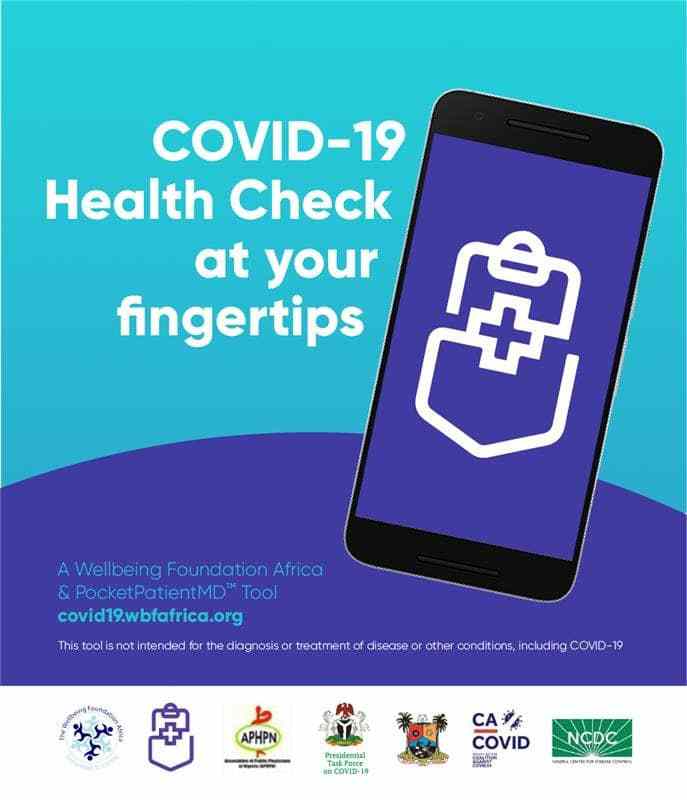
The e-health check tool is available for free at https://covid19.wbfafrica.org/ and users can access real-time updates on how to stay connected, safe, and healthy during the pandemic on Instagram and Twitter @Wellbeing_PPMD, and @WellbeingPPMD on Facebook.