Categories
It was an honour to serve on the judging panel for the inaugural Future Health Challenge, delivered by A Global Initiative by Abu Dhabi in collaboration with MIT Solve, during the WHO 79th World Health Assembly in Geneva, organised around the defining question of this moment in global health, how do we build health systems that anticipate, rather than simply respond?
Five extraordinary finalist teams presented solutions of genuine ambition and real-world evidence. The winner, ThinkMD from Australia, equips frontline health workers with mobile clinical decision-support tools that improve triage, treatment and referral while turning routine care encounters into real-time population health signals, already deployed across more than 9,000 frontline workers in 885 facilities, with demonstrated early warning capability preceding a cholera outbreak in Zambia.
Distinguished Finalists VectorCam, an AI-enabled mosquito surveillance system helping health systems detect vector risks earlier and target interventions before outbreaks escalate, and Huna Cancer Navigator from Brazil, applying AI to routine blood data to identify elevated cancer risk earlier and having screened more than 500,000 patients with hundreds of cases detected that would otherwise have gone unidentified far longer, each offered proof that anticipatory health intelligence is a present capability, deployable at scale, with measurable population health impact.
What emerged across five teams, five countries, and five entirely distinct approaches was a shared conviction that the solutions most likely to transform health outcomes are those designed to reach the communities carrying the greatest burden of preventable disease, a standard Wellbeing Foundation Africa holds its own work to.
Congratulations to all finalist teams, ThinkMD, VectorCam, Huna Cancer Navigator, SPAQ and Unread Signal, for the quality and ambition of the work presented, and to Future Health, a Global Initiative by Abu Dhabi, in partnership with MIT Solve, for convening a challenge that has advanced the field and set a standard for what innovation in anticipatory health systems can and should look like.
View this post on Instagram
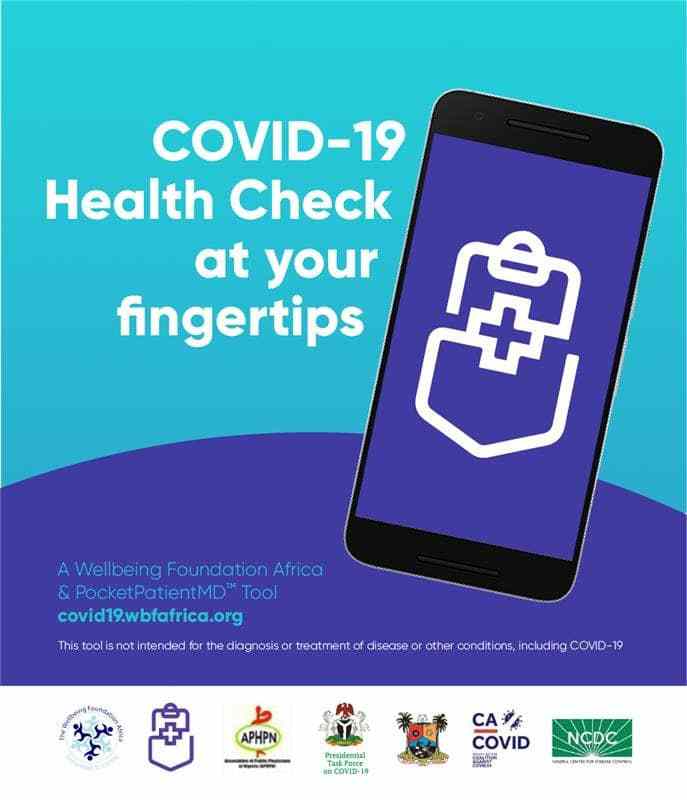
The e-health check tool is available for free at https://covid19.wbfafrica.org/ and users can access real-time updates on how to stay connected, safe, and healthy during the pandemic on Instagram and Twitter @Wellbeing_PPMD, and @WellbeingPPMD on Facebook.