Categories
I welcome the report released yesterday by the World Health Organization, Strengthening Capacity for Newborn Screening, Diagnosis and Management of Birth Defects, which urges every country to expand newborn screening so that early detection and timely treatment prevent avoidable death and lifelong disability among millions of children, a position that aligns closely with the work the Wellbeing Foundation Africa has undertaken in Nigeria and advocated for globally, with the understanding that the first days of life are where so much of a child’s developmental trajectory is determined.
The data the World Health Organization sets out are instructive, with an estimated 8 million infants born with a birth defect each year and such conditions now accounting for almost 8% of all deaths among children under 5, while roughly 90% of those born with serious birth defects live in low- and middle-income countries where screening, diagnosis and treatment remain least available. The same report records that between 2000 and 2023 the proportion of under-five deaths attributable to birth defects rose from 1% to 4% across sub-Saharan Africa and from 3% to 11% across South Asia, an epidemiological shift that reflects measurable gains against infectious disease alongside the unfinished task of addressing congenital and neonatal conditions.
Inspired by Disability Activist Oscar Anderson MBE’s leadership and lived experience, Project Oscar – Light For Life, a Neonatal Jaundice Screening, Treatment, and Kernicterus Prevention Programme at the Wellbeing Foundation Africa, was developed in direct response to precisely this evidence base, supported by our social impact partner Reckitt and delivered in collaboration with the London School of Tropical Medicine (LSHTM), NEST360, Solina Centre for International Development and Research (SCIDaR) and the Lagos Ministry of Health. In Nigeria, neonatal jaundice affects close to 60% of term newborns and almost all preterm infants, and it persists as a leading yet preventable cause of kernicterus, the bilirubin-induced brain injury that produces permanent neurological disability, which is why the programme equips facilities with phototherapy units and bilirubinometers, integrates the Picterus Jaundice Pro digital screening tool into frontline care, trains health workers in clinical management, and strengthens maternal awareness through our WBFA MamaCare360 antenatal and postnatal classes.
Newborn screening succeeds only where its results are recorded, retained and carried forward, which is why the Wellbeing Foundation Africa developed and drove the widespread adoption of the Nigeria Integrated Maternal, Newborn and Child Health Personal Health Record, a mother-held instrument that holds verifiable data from pregnancy to age five and gives each screening result a permanent place in a child’s continuity of care.
It is on this foundation that I highlight the World Health Organization’s call to integrate newborn screening, diagnosis and treatment into routine services and universal health coverage, beginning with the priority conditions each system can feasibly manage, so that no child is denied a healthy future because a treatable condition went undetected in the first days of life.
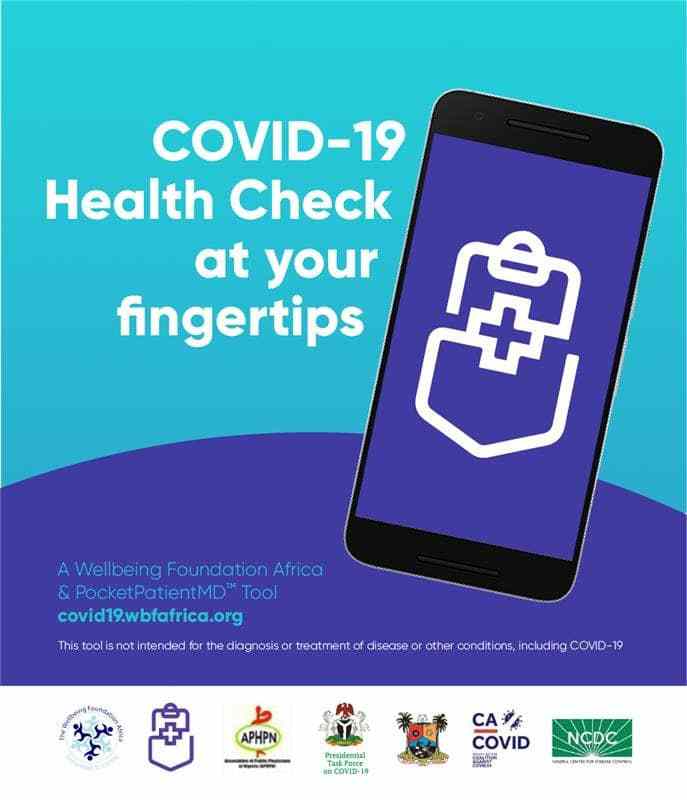
The e-health check tool is available for free at https://covid19.wbfafrica.org/ and users can access real-time updates on how to stay connected, safe, and healthy during the pandemic on Instagram and Twitter @Wellbeing_PPMD, and @WellbeingPPMD on Facebook.